Vacation-Proof Your Indoor Garden: Self-Watering Hacks for Renters
Leave town without killing your plants. These self-watering systems keep your indoor garden alive for 1-3 weeks while you are away - all renter-friendly with zero permanent installations.

The Vacation Dilemma
You have built a thriving indoor garden. Lettuce in the window, herbs on the counter, microgreens in rotation. Then comes the question: what happens when you leave for a week?
Finding a plant sitter is unreliable. Hoping for the best is risky. Coming home to dead plants is heartbreaking.
Here are five self-watering systems that work - tested through dozens of my own trips.
System 1: The Wine Bottle Dripper
Duration: 5-7 days
Difficulty: Easy
Cost: Free (uses recycled bottles)
The simplest solution. A wine bottle filled with water, inverted into your pot, slowly releases water as soil dries.
How to Set It Up
- Clean an empty wine bottle thoroughly
- Fill with water
- Quickly invert and push into soil (about 2 inches deep)
- Bottle will gurgle, then stabilize
Why It Works
As soil dries, air enters the bottle neck, allowing a small amount of water to escape. Wet soil creates a seal that stops flow. Self-regulating.
Pro Tips
- Test before you leave to see how fast your soil drains
- Works best in larger pots (small pots drain too fast)
- Push in at a slight angle for stability
- Use multiple bottles for large containers
Limitations
Not precise. Some plants get too much, some too little. Best for hardy plants that tolerate moisture fluctuation.
System 2: The Wicking Reservoir
Duration: 1-2 weeks
Difficulty: Medium
Cost: $5-10
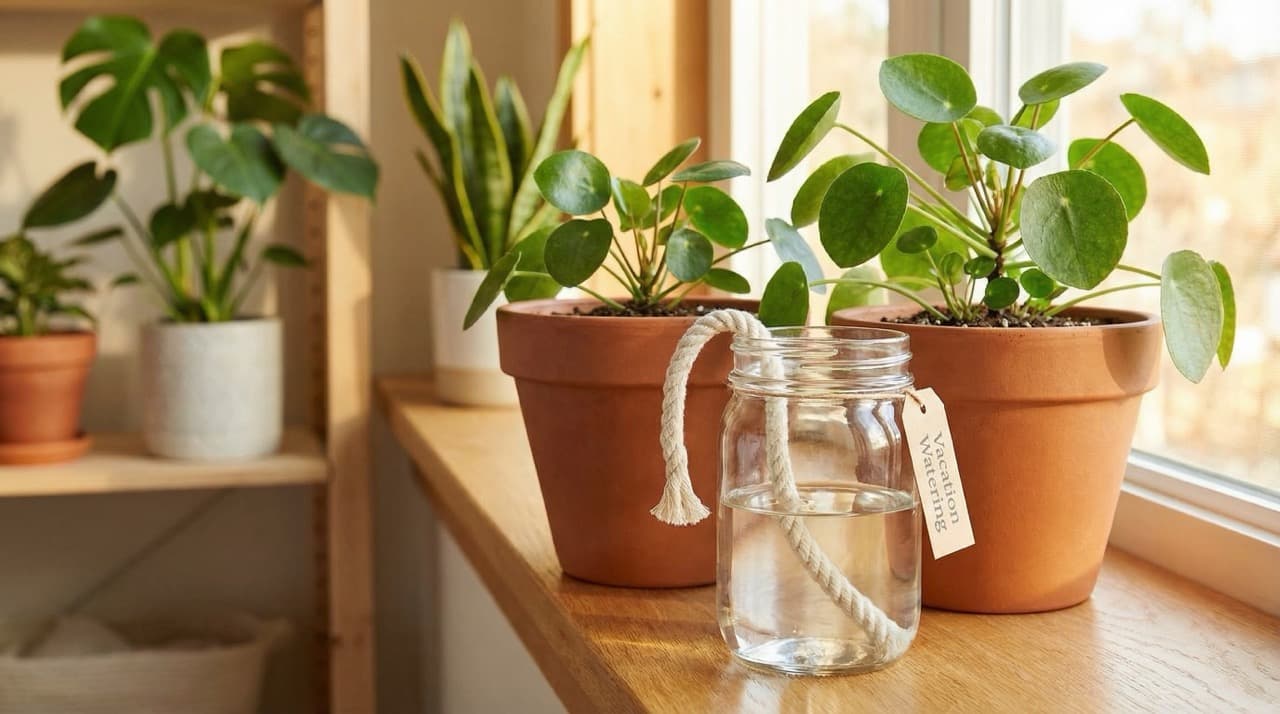
A fabric wick draws water from a reservoir into the soil. Continuous, slow, consistent hydration.
What You Need
- Large container for water reservoir (bucket, large bowl, storage container)
- Cotton rope or fabric strips (natural fiber only - synthetics do not wick)
- Something to hold wick in soil (chopstick, plant stake)
Setup Steps
- Cut rope/fabric to reach from reservoir bottom to pot center
- Fill reservoir with water
- Bury one end of wick 3-4 inches into pot soil
- Run other end into reservoir, touching bottom
- Position reservoir higher than pot for gravity assist (or at same level)
The Physics
Capillary action draws water up the wick continuously. Rate depends on wick thickness and soil dryness. Dry soil pulls harder.
Making It Work
- Use natural cotton or felt for wicks
- One wick per small-medium pot, two for large pots
- Test for 24 hours before leaving to ensure flow rate is right
- Larger reservoir = longer duration
System 3: The Bathtub Method
Duration: 1-2 weeks
Difficulty: Easy
Cost: Free
For a lot of plants, this is the simplest solution. Turn your bathtub into a self-watering greenhouse.
How It Works
- Place a towel or capillary mat in the tub
- Add 1-2 inches of water to tub
- Set all pots (without saucers) on the wet towel
- Close bathroom door partially (humidity retention)
Why Bathtubs Work
- The wet towel wicks water to pots from below
- High humidity reduces water loss from leaves
- Cool, consistent temperature in most bathrooms
- Contained space if anything overflows
Considerations
- Only works if your tub drains slowly (plug must hold)
- Light is limited - move plants back to windows after 2 weeks max
- Not for plants that need dry periods between watering
System 4: DIY Self-Watering Containers
Duration: 2-3 weeks
Difficulty: Medium
Cost: $10-20 per container
Build permanent self-watering into your containers. The reservoir is always there, refill when needed.
Basic Design
Two nested containers:
- Inner pot with drainage holes (holds plant)
- Outer container without holes (holds water reservoir)
- Wicking material connecting the two
Simple Version
- Take a plastic nursery pot with drainage holes
- Put a shallow sponge or felt in bottom of nursery pot
- Place nursery pot inside decorative pot (no holes)
- Water reservoir sits in outer pot, wick pulls it up
Advanced Version
Purpose-built self-watering planters with:
- Water level indicators
- Fill tubes for easy top-up
- Overflow drainage
These cost more but work better for long-term vacation-proofing.
System 5: The Cloche Humidity Trap
Duration: 1-2 weeks (for low-water plants)
Difficulty: Easy
Cost: Free
For plants that do not need much water, trap humidity instead of providing more water.
What It Is
A clear plastic cover that traps moisture evaporating from soil, creating a mini greenhouse.
DIY Options
- Large plastic bags over stakes (do not let bag touch leaves)
- Clear plastic storage containers inverted over pots
- Old aquariums or glass cloches
When to Use
- Succulents and low-water plants
- Short trips (under 2 weeks)
- Plants that hate wet soil but like humidity
Important
Do not use on plants that need good airflow. Do not place in direct sun (overheating). Remove immediately when you return.
The Pre-Vacation Checklist
No matter which system you use, do these things before you leave:
3 Days Before
- Water all plants thoroughly
- Remove any dead or dying leaves (they rot)
- Check for pests (you do not want an infestation brewing while you are gone)
- Test your watering system
1 Day Before
- Refill all reservoirs
- Move plants out of direct sun (reduces water needs)
- Close blinds partially (cooler = less evaporation)
- Lower thermostat if possible (cooler = less water needed)
Morning of Departure
- Final check of all water levels
- Ensure wicks are working
- Take a photo (for comparison when you return)
Matching System to Plant
High water needs (herbs, lettuce):
Wicking reservoir or bathtub method
Medium water needs (most houseplants):
Wine bottle dripper or self-watering container
Low water needs (succulents, cacti):
Cloche humidity trap or just thorough watering before leaving
The System I Actually Use
After years of experimenting, here is my standard vacation protocol:
For 1-week trips:
- Thorough watering day before
- Wine bottles in large pots
- Bathtub method for herbs and greens
For 2-week trips:
- Wicking reservoirs for everything
- Bathtub method for high-water plants
- Plants moved out of direct sun
For 3+ weeks:
- Find a plant sitter (some things cannot be automated)
- Or accept some losses and focus on saving the most valuable plants
The Psychology of Letting Go
Here is a hard truth: some plants will die when you travel. It happens. The goal is not perfection - it is minimizing losses.
Focus your best systems on:
- Plants that took months to grow
- Rare or expensive varieties
- Plants in active production
Let go of:
- Fast-growing greens (you can restart them)
- Cheap herbs (basil is $3 at the store)
- Anything struggling before you left
A thriving garden requires occasional travel. Build systems, accept some loss, and enjoy your time away.
For complete water management systems including mess prevention and the vacation watering matrix, see the Water and Mess Management chapter in Sky-High Harvest.